Guanqun Yang 杨冠群
My research focuses on scalable software testing and analysis using NLP methods. I develop automated solutions for ML model behavioral testing, security vulnerability management, and evaluating AI coding assistants.
Research (Stevens Institute of Technology)
Security and Privacy Vulnerabilities in Agentic LLM Workflows
Aug. 2025 – Present
Discovered a new class of docstring prompt-injection attacks in MCP tools by embedding misleading instructions inside tool schemas, causing LLM agents to invoke incorrect tools while bypassing mcpscan security scanning. Investigating privacy risks in agentic workflows using LangGraph where LLM assistants unintentionally leak sensitive user information during outbound communication to third-party services.
User Simulation for Evaluating AI Coding Assistants (SimVibeCoder)
Nov. 2025 – Present
Developing a user simulation framework that models users as adaptive, stateful entities maintaining structured goals and updating behavior based on agent actions. Unlike static-user benchmarks, this framework captures bidirectional human-AI co-evolution in coding interactions.
Scalable Security Patch Retrieval for Large Codebases
Jan. 2024 – May. 2025
Developed a scalable patch retrieval system using LLM embedding models fine-tuned to encode code patches and natural language security reports. Implemented efficient vector similarity search reducing search complexity from quadratic time to linear time.
Policy-Aligned Testing for Content Moderation (HateModerate)
Aug. 2022 – Jun. 2024
Developed a human-in-the-loop framework that tests hate speech classifiers against Facebook's 41 community content policies. Created test suites with 28 annotators and GPT, revealing substantial gaps between model behavior and platform guidelines. Fine-tuning on policy-aligned test cases improved model conformity without degrading general performance. (WOAH 2024 Outstanding Paper)
[ACL Anthology] – [GitHub]
Continuous Automated Red-Teaming of LLMs
Aug. 2022 – Dec. 2023
Developed an LLM-based red-teaming system using SFT-tuned GPT-J-6B to generate diverse yet constrained toxic content (e.g., target, type), uncovering failures in hate-speech detectors and inducing jailbreaks in GPT-3.5.
Automated Test Case Generation for NLP Model Validation (TestAug)
Aug. 2021 – Aug. 2022
Developed a system that efficiently generates high-quality NLP test cases with 98% manual effort reduction, achieving 9 to 49.4 times greater diversity compared to previous systems. Uncovered critical bugs in top-5 downloaded models on HuggingFace Hub.
Sample-Efficient NER for Security Vulnerability Reports (FewVuln)
Aug. 2020 – Aug. 2021
Developed a system to identify vulnerable software with 90% F1 in CVE vulnerability reports while utilizing no more than 10% of the annotated data than prior arts. Introduced Transformer fine-tuning into the security research community.
Projects
Knowledge Graph Construction and Reasoning
2019
Built an end-to-end knowledge graph system for movie recommendation. Extracted entities and relations from IMDb data, constructed a Neo4j graph database, and implemented graph-based reasoning for personalized recommendations using knowledge graph embeddings (TransE, DistMult).
Graph Neural Networks for Node Classification
2019
Implemented and evaluated Graph Convolutional Networks (GCN) and Graph Attention Networks (GAT) for semi-supervised node classification on citation networks (Cora, Citeseer, Pubmed). Achieved state-of-the-art results with custom message-passing layers.
Deep Reinforcement Learning for Game Playing
2018
Implemented DQN, Double DQN, and Dueling DQN agents to play Atari games. Explored techniques including experience replay, target networks, and prioritized sampling. Achieved human-level performance on several games.
Large-Scale Social Network Analysis
2018
Analyzed 1.6M+ travel records from Uber Movement data in San Francisco. Built graph representations, computed centrality metrics, and implemented community detection algorithms. Applied PageRank and graph clustering for transportation pattern discovery.
Previous Research (UCLA)
Fairness-Preserving Machine Learning
Sep. 2018 – Dec. 2019
Improved fairness in recommendation and classification systems by 25% and 7.43% respectively. Translated high-level fairness goals into actionable metrics and applied amortized reranking and adversarial training.
Guanqun Yang, Lingxiao Wang, Deep Learning under Fairness Constraint, 2019
[Full Text]Guanqun Yang, Fairness: What is the Right Thing to Do? A Comparative Study of Fairness-Preserving Algorithms, 2018
[Presentation Slide]-[Full Text]
Autonomous Motion Planning by Deep Reinforcement Learning
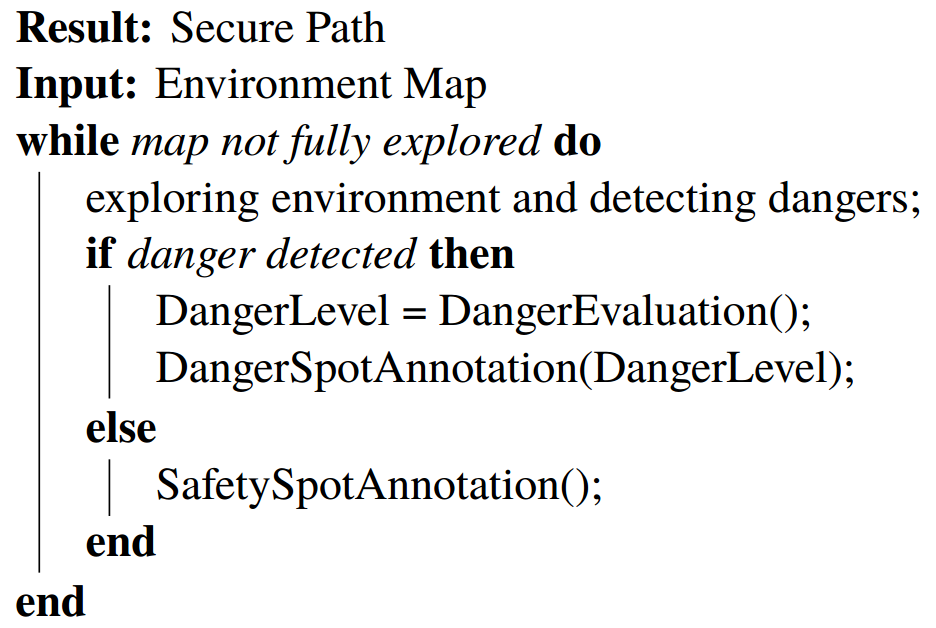 |
Implemented a system that detects danger factors in hospital environments and guides people to their destination via a secure route using deep reinforcement learning. The system consists of two parts: object detection (detecting danger factors with deep learning) and motion planning (generating secure paths with reinforcement learning). Technologies: TensorFlow, DQN, YOLO, path planning algorithms |
Guanqun Yang, Japan-US-Canada Advanced Collaborative Education Program (JUACEP), 2018 at Nagoya University
Advisor: Prof. Yoji Yamada
[Presentation Slide]-[Full Text]